
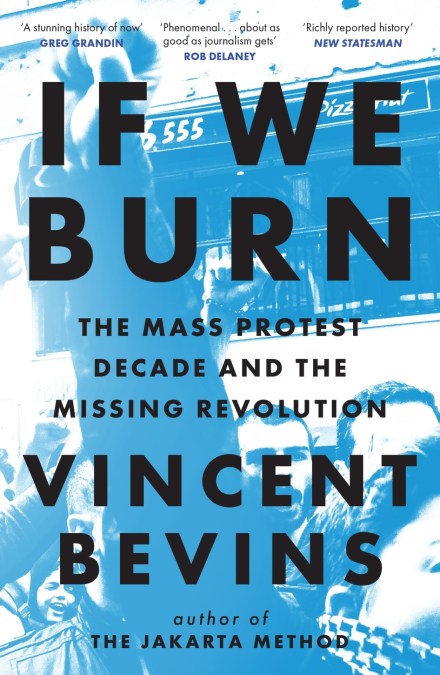
If We Burn: The Mass Protest Decade and the Missing Revolution
On sale
3rd October 2023
Price: £14.99
‘A stunning history of now’ GREG GRANDIN
‘Phenomenal . . . it would be criminally negligent not to read it if you’d like to change the world’ ROB DELANEY
From 2010 to 2020, more people took part in protests than at any other point in history. But what type of change did they deliver?
From the so-called Arab Spring and Gezi Park in Turkey, to Ukraine’s Euromaidan and student rebellions in Chile and Hong Kong, this decade was propelled by explosive mass demonstrations. If We Burn is a stirring global history guided by a single, puzzling question: how did so many mass protests lead to the opposite of what they asked for?
In this groundbreaking study of street movements and their consequences, acclaimed journalist Vincent Bevins weaves hundreds of interviews from around the world into a fast-paced, gripping narrative. Analysing both the successes and defeats, it allows us to understand our world in the present – and offers urgent lessons for the future.
More praise for If We Burn:
‘The best book I read this year’ EAMON WHALEN
‘In searching for the missing revolution, Bevins may help others find it after all’ LOS ANGELES REVIEW OF BOOKS
‘This book is outstanding’ BENJAMIN MOSER
‘Tremendous’ INTERCEPT
‘A bold vision of the future’ MERVE EMRE
‘A riveting, almost novelistic narrative’ DAZED
‘Critical lessons for activists both here and abroad’ NEW REPUBLIC
‘Phenomenal . . . it would be criminally negligent not to read it if you’d like to change the world’ ROB DELANEY
From 2010 to 2020, more people took part in protests than at any other point in history. But what type of change did they deliver?
From the so-called Arab Spring and Gezi Park in Turkey, to Ukraine’s Euromaidan and student rebellions in Chile and Hong Kong, this decade was propelled by explosive mass demonstrations. If We Burn is a stirring global history guided by a single, puzzling question: how did so many mass protests lead to the opposite of what they asked for?
In this groundbreaking study of street movements and their consequences, acclaimed journalist Vincent Bevins weaves hundreds of interviews from around the world into a fast-paced, gripping narrative. Analysing both the successes and defeats, it allows us to understand our world in the present – and offers urgent lessons for the future.
More praise for If We Burn:
‘The best book I read this year’ EAMON WHALEN
‘In searching for the missing revolution, Bevins may help others find it after all’ LOS ANGELES REVIEW OF BOOKS
‘This book is outstanding’ BENJAMIN MOSER
‘Tremendous’ INTERCEPT
‘A bold vision of the future’ MERVE EMRE
‘A riveting, almost novelistic narrative’ DAZED
‘Critical lessons for activists both here and abroad’ NEW REPUBLIC
Reviews
This book is phenomenal. A thrilling, blow by blow (and often live on-the-ground) analysis of how the various people-led movements and revolutions over the last decade succeeded or failed. Incalculably useful to anyone who'd like to make substantive, enduring changes to their town, country or even the world. It's an incredible follow up to The Jakarta Method - which focused on the development of the CIA and the seismic and often horrific global consequences - and sees Bevins applying his near-heroic methods of investigation to more recent events. It's about as good as journalism gets and Bevins is uniquely positioned to get the goods, just due to the sheer amount of time he spends in the places he writes about, fostering relationships and suffering from unquenchable curiosity. I cannot think of a book that so soberly and forensically analysed the very recent past and looked at what went right and what went terribly wrong. The highest praise I can give If We Burn is to say that it would be criminally negligent not to read it if you'd like to change the world. And why wouldn't you?
The best book I read this year.
In this remarkably assured and sweeping history of the present, Vincent Bevins asks some of the most urgent questions for contemporary life: How can a multitude of ardent, angry, and hopeful people harness their energies for profound political change? And what happens if they fail? If We Burn travels the world in search of an answer and, along the way, introduces us to the activists, hackers, punks, martyrs, and the millions of ordinary people whose spontaneous acts of bravery spurred the mass protests of the last decade. Bevins's clear-eyed, sympathetic account of the unfulfilled promise of these protests leaves his reader with a bold vision of the future - one in which his book's lessons are used to transform an uprising into a true revolution.
This book is outstanding.
Vincent Bevins' compelling new book, If We Burn, is a wondrous work of mystery writing, an effort to solve the riddle: why has a decade of large-scale rolling revolts produced no revolution, no significant structural reform? I can't think of any journalist other than Bevins who would dare to ask such a question, or be capable of weaving together seemingly discrete global events into a stunning history of now. Have we planted seeds for a better future or have the gears of change frozen for good? Bevins lets the people he talked to, those on the street, answer.
Crucially, the book draws deeply on protestors' own words. If We Burn thereby offers both a postmortem of the last decade of mass protest and a blueprint for the inevitable next. In searching for the missing revolution, Bevins may help others find it after all.
The critically acclaimed Jakarta Method was a scathing exposé of the central role the C.I.A. played in orchestrating Indonesia's savage 1965 anti-communist pogrom. If We Burn is both more ambitious and more wide-ranging.
Tremendous.
Vincent Bevins emerged as a leading chronicler of US empire in his 2020 book The Jakarta Method, in which he explored the dirty legacy of the Cold War. His new book, If We Burn, is more personal and even more urgent. And somehow, a little hopeful, too.
A riveting, almost novelistic narrative.
Bevins has spent the last 10 years or so following and interviewing in search of answers. 'The point was not just to notice that the mass protest decade hasn't really worked out,' he muses toward the end of the book. 'The idea was to understand why.' Fortunately, he comes away from his globe-trotting search with critical lessons for activists both here and abroad.