
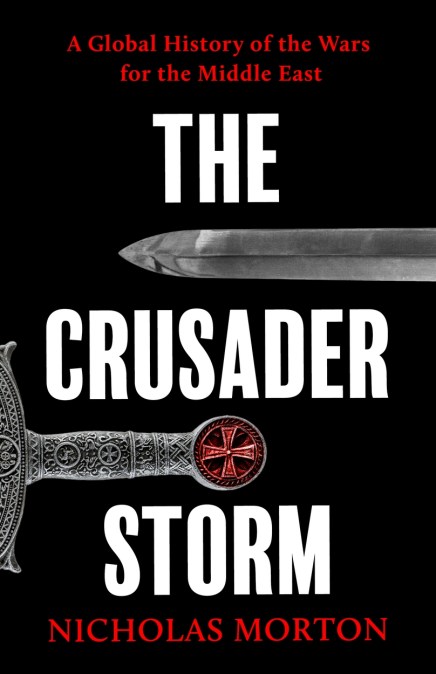
The Crusader Storm
On sale
4th June 2026
Price: £25
Genre
‘Bold, vital and urgent . . . Blows the old parochial Western accounts clean away’ SUZANNAH LIPSCOMB
A spectacular new panoramic history of the Crusades.
From their foundation in 1097 to Saladin’s conquest of Jerusalem almost a century later, the Crusader States transformed the Middle Eastern world. In an era shaped by many conflicts, this was not simply a war between Christianity and Islam, but an epic contest among multiple rival empires, dynasties and cultures.
The Crusader Storm unfolds through a kaleidoscope of perspectives: a Byzantine renegade, a crusader princess, a Turkish matriarch, a young Arab nobleman, a Syriac archbishop, Saladin’s leading commander and the vizier of Egypt. Between them, information, technologies and ideas – as well as weapons – crossed borders at astonishing speed as their societies fought, allied and traded. Their entangled fates reshaped not only the Middle East, but the medieval world itself.
Drawing on sources from Arabic, Greek, Syriac, Armenian, Latin and Hebrew traditions, Nicholas Morton’s enthralling panorama transforms our understanding of the Crusades – revealing them not as a single clash of faiths, but as a dynamic era of war, commerce, innovation and exchange that defined the course of history.
PRAISE FOR THE MONGOL STORM:
‘Brain-stretching . . . Pulsating . . . Irresistible’
SUNDAY TIMES
‘Deeply researched and elegantly written – essential reading’
DAN JONES
‘Erudite . . . Thrilling and much-needed’
DAILY TELEGRAPH
‘Revelatory, lively and stocked with colourful personalities’
LITERARY REVIEW
A spectacular new panoramic history of the Crusades.
From their foundation in 1097 to Saladin’s conquest of Jerusalem almost a century later, the Crusader States transformed the Middle Eastern world. In an era shaped by many conflicts, this was not simply a war between Christianity and Islam, but an epic contest among multiple rival empires, dynasties and cultures.
The Crusader Storm unfolds through a kaleidoscope of perspectives: a Byzantine renegade, a crusader princess, a Turkish matriarch, a young Arab nobleman, a Syriac archbishop, Saladin’s leading commander and the vizier of Egypt. Between them, information, technologies and ideas – as well as weapons – crossed borders at astonishing speed as their societies fought, allied and traded. Their entangled fates reshaped not only the Middle East, but the medieval world itself.
Drawing on sources from Arabic, Greek, Syriac, Armenian, Latin and Hebrew traditions, Nicholas Morton’s enthralling panorama transforms our understanding of the Crusades – revealing them not as a single clash of faiths, but as a dynamic era of war, commerce, innovation and exchange that defined the course of history.
PRAISE FOR THE MONGOL STORM:
‘Brain-stretching . . . Pulsating . . . Irresistible’
SUNDAY TIMES
‘Deeply researched and elegantly written – essential reading’
DAN JONES
‘Erudite . . . Thrilling and much-needed’
DAILY TELEGRAPH
‘Revelatory, lively and stocked with colourful personalities’
LITERARY REVIEW
Newsletter Signup
By clicking ‘Sign Up,’ I acknowledge that I have read and agree to Hachette Book Group’s Privacy Policy and Terms of Use
Reviews
As hot desert winds to cobwebs, Nicholas Morton's bold, vital and urgent global history of the Crusades blows the old parochial Western accounts clean away
Nicholas Morton is a prolific and distinguished scholar of the Crusades whose work continues to reflect a sustained commitment to bringing the history of the medieval world to a broader readership
An innovative take on the early Crusades, firmly situating them within the broader medieval Near East. Approaching from over a dozen individual perspectives (empress, sultan, princess, nobleman, patriarch, assassin) Nicholas Morton weaves a dizzying array of contexts into a coherent whole, one in which the Crusades become an integral piece of a larger civilizational story. In these pages complexity reigns: adversaries become allies, political and religious interests intertwine, and fanaticism and avarice give way to tolerance and friendship - and back again. Challenging binary notions of Muslim-Christian, right-wrong, and good-bad