
Blood and Treasure
On sale
4th June 2026
Price: £12.99
Blood and Treasure is the story of the economics of conflict from the Viking Age to the war in Ukraine.
‘Absolutely fascinating and totally absorbing’ JAMES HOLLAND
‘A brilliant book’ MARTIN WOLF, FINANCIAL TIMES CHIEF ECONOMICS EDITOR
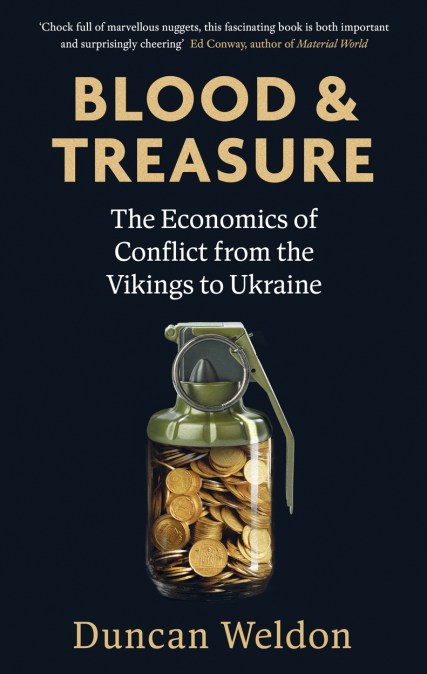
‘Chock full of marvellous nuggets, this fascinating book is both important and surprisingly cheering’ ED CONWAY
‘A delightfully quirky approach to military history’ SPECTATOR
Wars are expensive, both in human terms and monetary ones. But while warfare might be costly it has also, at times, been an important driver of economic change and progress. Over the long span of history nothing has shaped human institutions – and thus the process of economic development – as much as war and violence.
Blood and Treasure looks at the history and economics of warfare from the Viking Age to the war in Ukraine, examining how incentives and institutions have changed over time. Along the way it asks whether Genghis Khan should be regarded as the father of globalisation, explains how New World gold and silver kept Spain poor, asks if handing out medals hurt the Luftwaffe in the Second World War and assesses if economic theories helped to create a tragedy in Vietnam.
‘Absolutely fascinating and totally absorbing’ JAMES HOLLAND
‘A brilliant book’ MARTIN WOLF, FINANCIAL TIMES CHIEF ECONOMICS EDITOR
‘Chock full of marvellous nuggets, this fascinating book is both important and surprisingly cheering’ ED CONWAY
‘A delightfully quirky approach to military history’ SPECTATOR
Wars are expensive, both in human terms and monetary ones. But while warfare might be costly it has also, at times, been an important driver of economic change and progress. Over the long span of history nothing has shaped human institutions – and thus the process of economic development – as much as war and violence.
Blood and Treasure looks at the history and economics of warfare from the Viking Age to the war in Ukraine, examining how incentives and institutions have changed over time. Along the way it asks whether Genghis Khan should be regarded as the father of globalisation, explains how New World gold and silver kept Spain poor, asks if handing out medals hurt the Luftwaffe in the Second World War and assesses if economic theories helped to create a tragedy in Vietnam.
Reviews
This is an absolutely fascinating and totally absorbing book and one that could not be more prescient. Weldon masterfully underscores the historical and ongoing - yet complex - connections between wars, economic development and institutional evolution. Full of wisdom and rich in depth and detail, this does much to further our understanding of the troubled world in which we live today. Brilliant
War and wealth, or 'blood and treasure', are intimately connected. Thus, war is also an economic activity: it has economic motivations, demands economic resources and has economic consequences. But, over time, as Duncan Weldon explains in this brilliant book, those motivations, resources and consequences have changed. That evolution is not just the result of political and economic developments, but also a leading cause of them. The good news is that the economic gains from major wars have collapsed as the costs have soared. The bad news is even this may not be enough to curb humanity's horrifying propensity for mass conflict.
Journalist and former economist Duncan Weldon explores how war and violence have driven economic change and human progress through history... the author's deep analysis, from the Vikings to the war in Ukraine, proves that conflict has indeed shaped institutions and, in turn, economic outcomes - for better or worse. Fascinating and full of historical detail
Chock full of marvellous nuggets, this fascinating book is both important and surprisingly cheering. As the world creeps towards war, we all need to understand the economics behind conflict. But, as this book so brilliantly shows, sometimes it takes war itself to teach us the most profound economic lessons about ourselves
A delightfully quirky approach to military history... Thanks to an obvious deep love of the subject, a deft choice of examples and some thoroughly satisfying human stories... Weldon has made warfare a good thing to read about
Time and again Weldon spots the invisible hand behind hostilities