
From the Front line
On sale
18th June 2026
Price: £25
Genre
“There are always good reasons for reading Grossman, but few times are as resonant as our own” Financial Times
“At the heart of his writing lies a tireless humanity and empathy” Telegraph
“Grossman combines a journalist’s eye with a novelist’s empathy” Spectator
“Grossman is the Tolstoy of the USSR” Martin Amis
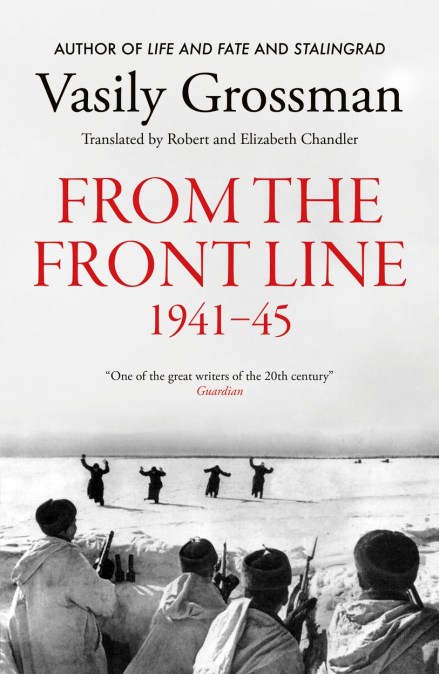
June 22, 1941: Launch of Operation Barbarossa. Hitler invades the Soviet Union. Vasily Grossman soon begins a new career as a war reporter.
During the next four years, he covers all the major battles of the Eastern Front, from Stalingrad to Berlin, crafting brutally vivid reports that were read by millions of soldiers and civilians alike. And, as the war draws to a close, he was one of the first to expose the horrors of the Treblinka death camp.
Grossman had a remarkable memory and the ability to win the trust of men and women from all walks of life: snipers, generals, fighter pilots, peasants, soldiers in a Soviet penal battalion and German prisoners of war. And his ability to write so vividly, and with such understanding, about world-changing events while they were still unfolding may well be unique.
This collection brings together the best of the forty-nine articles he wrote for the Red Star newspaper, often in newly unearthed versions that have not been distorted by censors. It demonstrates more clearly than ever what an extraordinary amount Grossman witnessed during only a few years.
Translated from the Russian by Robert and Elizabeth Chandler
Introductory material, notes and editorial apparatus by Robert Chandler and Julia Volohova
“At the heart of his writing lies a tireless humanity and empathy” Telegraph
“Grossman combines a journalist’s eye with a novelist’s empathy” Spectator
“Grossman is the Tolstoy of the USSR” Martin Amis
June 22, 1941: Launch of Operation Barbarossa. Hitler invades the Soviet Union. Vasily Grossman soon begins a new career as a war reporter.
During the next four years, he covers all the major battles of the Eastern Front, from Stalingrad to Berlin, crafting brutally vivid reports that were read by millions of soldiers and civilians alike. And, as the war draws to a close, he was one of the first to expose the horrors of the Treblinka death camp.
Grossman had a remarkable memory and the ability to win the trust of men and women from all walks of life: snipers, generals, fighter pilots, peasants, soldiers in a Soviet penal battalion and German prisoners of war. And his ability to write so vividly, and with such understanding, about world-changing events while they were still unfolding may well be unique.
This collection brings together the best of the forty-nine articles he wrote for the Red Star newspaper, often in newly unearthed versions that have not been distorted by censors. It demonstrates more clearly than ever what an extraordinary amount Grossman witnessed during only a few years.
Translated from the Russian by Robert and Elizabeth Chandler
Introductory material, notes and editorial apparatus by Robert Chandler and Julia Volohova
Reviews
In [From the Front Line] we already sense a writer with a gimlet eye for detail, instinctive empathy and a grasp of the epic scale on which his two big novels would unfold
Vasily Grossman is the Tolstoy of the USSR
Grossman perfected a [journalistic] style that relied less on rhetoric than on the power of witness . . . Grossman's reporting paints a war epic in miniatures, selecting subjects with an eye toward mystery, uncertainty, and the compromised character of men whom he was encouraged to cast as uncomplicated heroes
[Grossman] managed to produce first-rate journalism that is also of lasting quality as artful prose . . . [From the Front Line] presents the reader with great matter-of-fact prose in the same lineage as Leo Tolstoy and Anton Chekhov while also offering invaluable coverage of the Eastern Front during World War II
For the Second World War, or Great Patriotic War as it is known in Russia, the most renowned writer is Vasily Grossman
Grossman's writing features sweeping, almost lyrical descriptions of landscapes ravaged by war . . . and vivid combat scenes that capture human frailty at the mercy of mechanized violence . . . It's a powerful evocation of a world at war
Grossman was an extraordinary writer. If you want to know not only what happened during the war in the east, but how it was experienced by those caught up in it, he is peerless-at once clear and vivid, with a masterful sense of when to be prosaic and when poetic, when naturalistic and when rhetorical, all underpinned by a genuine moral rigour intermittently betrayed by the interventions of his editors in Moscow